
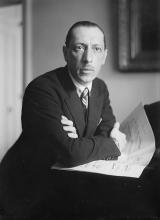
Igor Stravinsky (1882-1971) is often considered something of a revolutionary, in part based on the riotous reception of his ballet The Rite of Spring. Stravinsky's career, however, suggests more evolution than revolution. Perhaps no other composer in this century -- or any -- has written in such a variety of styles. And it is the unique genius of Stravinsky that his musical personality is detectable in each of these styles.
Stravinsky came from a musical family, although his training was limited, reflecting his family's desire that he pursue studies in law. As a student at the university in St. Petersburg, he made the acquaintance of Nicolai Rimsky-Korsakov, and studied with the older composer. His music quickly caught the attention of Serge Diaghilev, the director of the Ballets Russes in Paris. Stravinsky was commissioned to write a ballet for the theater, his Firebird. This was quickly followed by Petrushka and The Rite of Spring.
Stravinsky continued his association with Paris, but with the advent of World War I and the turmoil in Russia that would lead to the October Revolution, Stravinsky took refuge in Switzerland. After the war he returned to Paris, writing more ballets for Diaghilev, as well as a wide variety of other works, many (such as his Piano Concerto) serving as performance vehicles for the composer. In 1939, he emigrated to the United States, where he attempted unsuccessfully to write music for films. He continued composing late into his life, and when he was well into his eighties he embarked on a full schedule of performances as conductor, both in concert and on record. These recordings serve as valuable documentation of Stravinsky's ideas concerning his own music.
Along with his changing nationalities, Stravinsky's music underwent remarkable change over the course of his life. His early music (for example, the Symphony in E flat) show the influences of his Russian models. His ballets show a wider range of influences, including that of Claude Debussy. By The Rite of Spring, Stravinsky had broken new ground entirely, writing in a complex rhythmic style and a harmonic style that included the use of polytonality. This increasing complexity came to an abrupt end with his move to Switzerland, and he produced a seminal group of pieces in a pared-down instrumental style (often without strings), the most notable being the small dramatic work, Histoire du soldat for four speakers and a small instrumental ensemble. When he returned to Paris, he continued this more austere style, and added to it an interest in older forms and methods, beginning his well-known neoclassical period. The culmination of this can be seen in his opera The Rake's Progress, a modern adaptation of the classical style of Mozart's late comedies. Late in his life, Stravinsky once more changed styles, embracing the methods of twelve-tone and serial composition. What resulted is a remarkable series of works including his ballet Agon and a great deal of religious music.
In all these works, certain qualities remain constant. First and foremost is a clarity of sound, an almost transparent texture heightened by his masterful use of orchestration. Along with this is an approach to rhythm that articulates his melodies with a certain dryness, adding to the clarity of sound. Finally, there is a concise and economical approach to form. This has its roots in the simplified style of his music from the 1920s, but was a hallmark of his style throughout his career.